

Table of Contents
Why do networking teams need to prioritize upskilling now?
The shift to AI-driven networking has transformed the network engineer role into a software-centric discipline, and the gap between required and existing skills is widening rapidly.
Across both enterprises and service providers, networks are becoming more programmable, automated, and data-driven. Traditional CLI-based operations are no longer making a cut. Instead, networking teams must develop new skills in Python, APIs, data analytics, ML fundamentals, and automation frameworks to stay competitive.
Industry data shows how urgent the need for upskilling has become:
Network engineers are strong in networking, weaker in automation.
In the 2025 State of Network Automation survey, 74% of respondents rated themselves highly skilled in networking, while only 44% said the same for automation. At the same time, over 91% reported that network engineers with automation skills are the ones actually building network automation in their organisations.Python has become the de facto language of network automation.
The same survey found that over 92% of respondents use Python for network automation, making it by far the most commonly used scripting language across enterprise and service provider environments.Skills shortages in network engineering and security are already a risk factor.
In Fortinet 2024 global skills gap report, 70% of IT decision-makers said the cybersecurity skills shortage creates additional risk for their organisations, and 62% highlighted finding candidates with specific network engineering and security experience as their greatest hiring challenge.
How is AI changing the role of network engineers?
AI requires network professionals to think like software developers because today’s networks operate through code and continuous integration rather than manual configuration.
Modern network engineering now centers around:
1. Programmability over manual configuration
API-based workflows, JSON payloads, and scripted network actions have replaced manual commands and device-by-device changes.
2. Automation as the default operating model
Automation reduces outages, speeds deployments, and handles repetitive tasks at scale. Engineers must be able to create, run, and maintain automation pipelines using Python or low-code frameworks.
3. Data-driven decision-making
AI-driven observability tools produce vast telemetry streams. Engineers must interpret data patterns, anomalies, and correlations – and work closely with ML-generated insights to optimize operations.
4. Collaboration between networking and software teams
The traditional boundaries are dissolving. Network engineers increasingly collaborate with DevOps, cloud engineering, and data teams, requiring shared language and tooling.
Networking is now a software discipline with networking expertise layered on top, not the other way around.
What should a network engineer upskilling program include?
Effective upskilling requires a structured, continuous learning program, not one-off workshops or certifications.
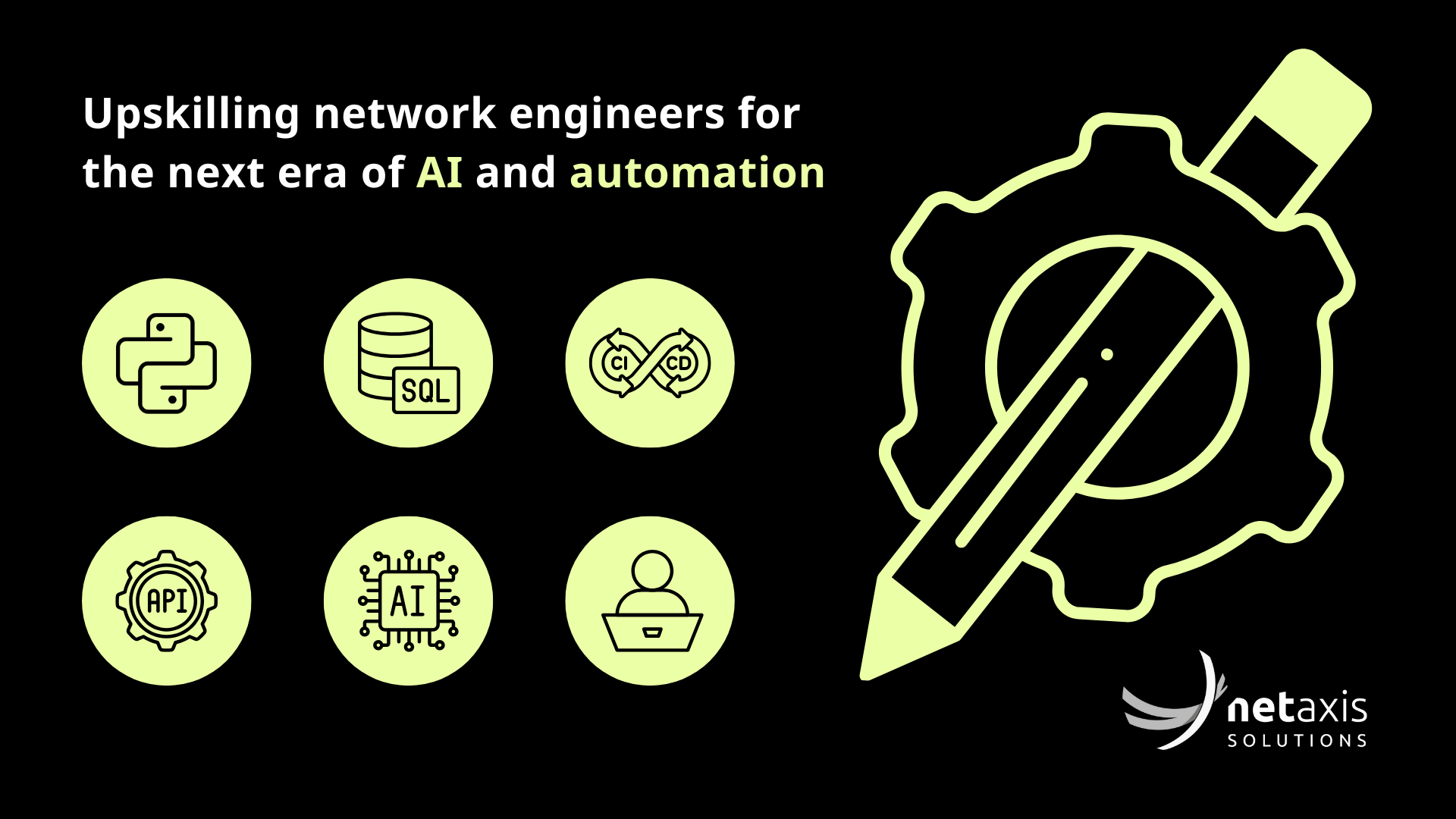
1. Python for network automation
Network engineers should be comfortable writing scripts, manipulating APIs, building basic automation logic, and working with Python libraries such as Netmiko, Nornir, or Requests.
2. Deep knowledge of APIs
RESTful APIs are now the backbone of modern network platforms, controllers, and orchestration systems. Engineers must know how to authenticate, send requests, parse responses, and integrate APIs into tooling.
3. Data analytics for network health
Training in data querying (SQL/Pandas), visualization (Grafana/Power BI), and anomaly detection helps teams harness telemetry and extract insights at scale.
4. Machine learning fundamentals
Engineers don’t need to be ML specialists, but they should understand concepts like feature extraction, model outputs, clustering, and anomaly scoring, allowing them to work effectively with AI-driven systems.
5. Automation frameworks and CI/CD integration
Skills in Git, pipelines, configuration repositories, and automation toolchains position teams to operate networks with software-like reliability and speed.
6. Continuous training and mentoring
AI and automation evolve quickly. Organizations must commit to ongoing skill reinforcement, not a one-time training exercise.
How can enterprises and service providers accelerate the networking team upskilling?
The fastest results come from creating a cohesive, ongoing skills strategy, not leaving learning up to your teams.
Create a structured training roadmap for all network engineering roles.
Allocate dedicated paid learning time – even 4 hours per week can dramatically accelerate progress.
Use real production use cases to reinforce automation, observability, and AI workflows.
Build internal mentorship channels pairing engineers strong in automation with those transitioning into software-centric roles.
Partner with vendors who provide automation-ready platforms, labs, and educational materials.
Measure progress with clear milestones: API proficiency, scripting ability, or automation ownership.
Organizations that invest aggressively now will build the next generation of network engineers, professionals capable of supporting AI-driven infrastructures at global scale.
Netaxis Solutions: Partnering on skills, not just platforms
Netaxis Solutions help telecom operators and their teams accelerate network automation with providing programmable platforms and expert services.
For enterprises and service providers, the challenge is not just teaching network engineers new concepts, it is giving them practical environments in which to use those skills safely, at scale. This is where Netaxis platforms such as SRE (Session Routing Engine) and APIO (API Orchestrator) make a difference.
Netaxis SRE and APIO are foundational platforms for service creation and routing in next-generation telecom networks, backed by expert consulting and support.
For enterprises and service providers, building an upskilling strategy, this creates a dual opportunity:
Deploy automation-ready platforms that reduce complexity, mitigate human error, and improve availability.
Use those same platforms as a training ground where network engineers learn to think in APIs, data models, and software-driven workflows.
Netaxis does not just modernise the network; it provides the kind of programmable, observable, and automatable environment that helps networking teams become the software‑centric engineers the AI era demands.